Where has the summer gone? I've finished the required museum visits, but I'm far from satisfied. I'll probably have to go to DC again this weekend or next week and get some more research in. Find some more artists to research, etc. Between the 50 artists and the full sketchbook, to say I'm having troubles would be a massive understatement. At least I figured out early on that my concept- or at least my medium- wouldn't work out. I'll probably have to set up my old computer and CS2 and fiddle around a bit, but I've been putting it off because my room gets unbearable during the day. I'd really love to be able to get into the studios at NVCC, since I tend to have 2-3 hours to kill between my morning and afternoon classes Monday and Wednesday, and I've been itching to do some printmaking. Cest la vie.
Museum Visits: Check
Works: ~1/3-5
Showing posts with label artists. Show all posts
Showing posts with label artists. Show all posts
13 July 2010

07 June 2010
Artists 11-20
11] Francis Cotes
Cotes uses thin washes of oil in many of his works, imitating his earlier styles in pastel. He gives much attention to detail, especially in regards to costume of the model, and the folds and sheens of his painted fabric are full of life. There is a sharp contrast between the dark background and the light, airy colors of the foreground figure, drawing attention to her pale skin and her sumptuous gown. An avid sewer, I cannot help admiring the beautiful detail of the gown, such as the gathered pink busk or feathery layers of the sleeves, and the sheer overlay of white over the central pink panel of the skirt is masterfully painted.
12] Edouard Manet*
13] Frank Lloyd Wright
The house is literally built over a waterfall, and is composed of simple elements such as cantilevered concrete slabs and stacked rock walls. What inspires me about this piece is how well, despite its materials, it blends into its natural surroundings. Rather than detracting from the beauty of the area, it adds to it.
14] Frank Stella
Not only is this work modular in design, but it does not stick to a strict rectangular format, instead breaking the usual frame and becoming even more abstract. Stella combines shapes such as squares and half-arches, and although each is separated by a border, the elements all blend together through the direction of the lines within them and the repetition of color patterns.
15] Georges Braque
16] Gustave Courbet
17] Jean Auguste Dominique Ingres
18] Grant Wood
19] Tim Hawkinson
20] Victor Vasarely
*These artists will be discussed in depth separately.
Artists 1-10
Ron Arad
A flexible bookcase, "Bookworm" is both functional and a work of art. The bright colors catch the eye, and the flexibility of the material enables the viewer to interact with the piece.
Antonio Testa
This micromosaic, "Panoramic View of Rome From the Janiculum Hill," from 1800-25 supposedly took Testa 20 years to complete*. I’ve always been impatient with my art, and the example of this artist’s dedication and patience to an obviously challenging work is inspiring. The message I took away from this piece was that it’s okay to slow down and take your time, and even work on multiple pieces at once- as long as you get it done in the end.
*According to the Victoria and Albert Museum: http://www.vam.ac.uk/images/image/57001-popup.html
Arthur Rackham
Arthur Rackham was an English book illustrator and he lived from 1867 to 1939. He illustrated several well-known works, such as a British version of the Grimm Fairy Tales, and Alice’s Adventures in Wonderland, by Lewis Carrol. I saw a collection of Arthur Rackham’s illustrations in the Victoria and Albert museum in London, and was drawn to his use of lines and often muted colors. I had also seen his illustration of Richard Wagner’s /The Ring/, “Rhine Maidens Warn Siegfried,” referenced in an article on water spirits, and loved the whiplash curves of the maidens’ hair and the low saturation of the piece in general. I’d explored the idea of illustration briefly at the beginning of the summer, when I viewed Rackham’s works at the V&A.
Dan Flavin
Dan Flavin worked primarily in the medium of florescent light, altering the medium to suit his ideas. Rather than crafting custom neon lights, Flavin used readily available florescents in common sizes, beginning with only straight lights, but progressing to circular and curved shapes later in his career. This particular work takes advantage of light's natural diffusion, reflecting the image in shattered material and the floor, even as the lights cast a colored glow against the wall.
5] Danny Lane
Danny Lane's glass sculptures such as "Parting of the Waves"
highlight the fluid nature of molten glass, while his furniture uses a comparatively fragile medium to challenge expectations.
6] Bjorn Wiinblad
Wiinblad designed exquisite pen patterns for porcelain pieces ranging from vases to dinner sets. His use of a single color in this series keeps the complicated line drawing from overwhelming the delicate porcelain.
7] Cicely Mary Barker
With a strong attention to detail, Barker renders the elderberry plant beautifully. The contrast between her comparatively strong outlines and the delicate wash of the leaves and backgrounds is particularly stunning, as is the juxtaposition of the dark blue-black berries against the light background.
8] Charles Robinson*
9] Charles Sheeler*
10] Caspar Wolf*
*These artists will be discussed in depth separately.
02 June 2010
Travel Inspiration
While I travel, my best friend tends to be my camera. This trip, I had to buy a new memory card, I took so many photos (by the way, souvenir shops on the way to Musee d'Orsay- ripoff on memory cards)! I figured I'd start with Germany, since we only spent one or two days in London, and I want to keep my museum visits in separate posts.

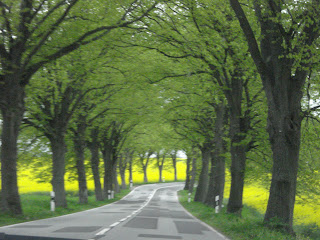
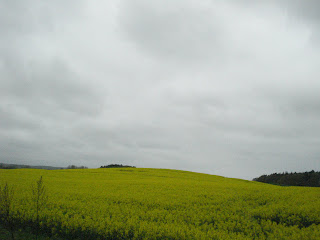
These three images are of the mustard fields in Germany. The first is from along the road from Hamburg to Rostock, and the other two are from Rostock to Rerik and Rostock to Berlin. Having traveled by train in the US, and driven, etc, and growing up in the suburbs, such vast amounts of farmland are astonishing. Not only farmland, but primarily mustard crops. I'd never seen mustard in anything other than a jar before, and the color, even on cloudy days, took my breath away. As I mentioned in an earlier post, there were often trails or green or brownish fields bordering the mustard, leading me to the idea of a bright yellow egg with green or brownish trails.


These three images are of the mustard fields in Germany. The first is from along the road from Hamburg to Rostock, and the other two are from Rostock to Rerik and Rostock to Berlin. Having traveled by train in the US, and driven, etc, and growing up in the suburbs, such vast amounts of farmland are astonishing. Not only farmland, but primarily mustard crops. I'd never seen mustard in anything other than a jar before, and the color, even on cloudy days, took my breath away. As I mentioned in an earlier post, there were often trails or green or brownish fields bordering the mustard, leading me to the idea of a bright yellow egg with green or brownish trails.
30 May 2010
Updates
So, I'm finally back from my trip and recovered from jet lag.
Museum tally:
* Britain- Victoria and Albert, Windsor Castle (Although not an art museum, it did have an astonishing collection of art)
* France- Musee d'Orsay (couldn't take photos, but it was /amazing/!), Louvre (many, many pictures there), Versailles (again, not technically an art museum, but quite a collection of paintings)
Total: 3 art museums, 2 others
I haven't had a chance yet to put my travel sketches in my summer sketchbook, let alone scan them, as I've been working on something very special at my internship. I'm interning in the education department at the Udvar-Hazy branch of the National Air and Space Museum, and we've been trying to find ways to make it a little more art, not just science. As a result, I'm creating a coloring book page for our "Become a Pilot Day" event on the 19th. It's a copy of a mural in the museum, "Celebrating 100 Years of Powered Flight" by Dr. Robert McCall. It's very exciting, but it's keeping me very, very busy. I can't post the image or my coloring sheet, but I can link to the artist's site: http://www.mccallstudios.com His paintings, especially his futuristic landscapes and cityscapes, are absolutely stunning.
19 May 2010
Not an actual post D:
Just to point out that I am active. I've been taking photographs galore and sketching to keep my muse active, but I can't upload anything until I get home (forgetting cords is not fun). Anyway; updates!
Museum tally:
Victoria and Albert (London): check
While I was at the V&A, I came across something very cool: micromosaics. As the name implies, they're mosaics made with teeny-tiny pieces. They looked almost like the brushstrokes of paintings! I'll do an actual post about them later, with photos and artists, but their intricacy and the persistance required to complete them was astounding. One artist is rumored to have spent ~20 /years/ on /one/ micromosaic! Obviously I hope it won't take me 20 years to complete this project, but I hope I can put as much of myself into my work as those artists did.
Planned museums:
Something in Berlin
Louvre
Musee d'Orsay
Versailles
Tate British or Tate Modern
That's all for now! G'night all!
10 May 2010
Trial and Error
I hate my cat sometimes. It took me about an hour trying to hollow out the duck and quail eggs. The duck eggs went fine; the quail not so much. Out of 6 attempts, I got only 2 un-cracked, hollowed eggs. So, naturally, my cat decided to tip the carton off the table to play with. C'est la guerre.
I ordered 4 pre-emptied emu eggs and some shell pieces on eBay last night. I'll probably start working on a design now, and practice on the shell pieces before trying my luck on the actual eggs. Here's hoping Dad has a dremel tool, as I forgot mine back at CNU. I should probably look into getting one of those pen-like attachments, so it's a little less bulky.
I've also been poking around the internet, and finding more books and artists to check out. My current plan of attack artist-wise is to see if there are other pysanky artists out there and what they're up to. Whether it's turning an egg into a Dalek or other contemporary design (which I've seen and loved- just need to find the link again) or using traditional designs on non-traditional eggs (like emu and ostrich eggs- waiting on a response from that artist re. use of images). I'm also going to look through other modern/contemporary artists and see if anything strikes me. A little broad, I know, but at the moment, it's what I've got.
Subscribe to:
Posts (Atom)